
Bitcoin April 2026 Rally: Record ETF Inflows & MicroStrategy’s $2.5B Buy
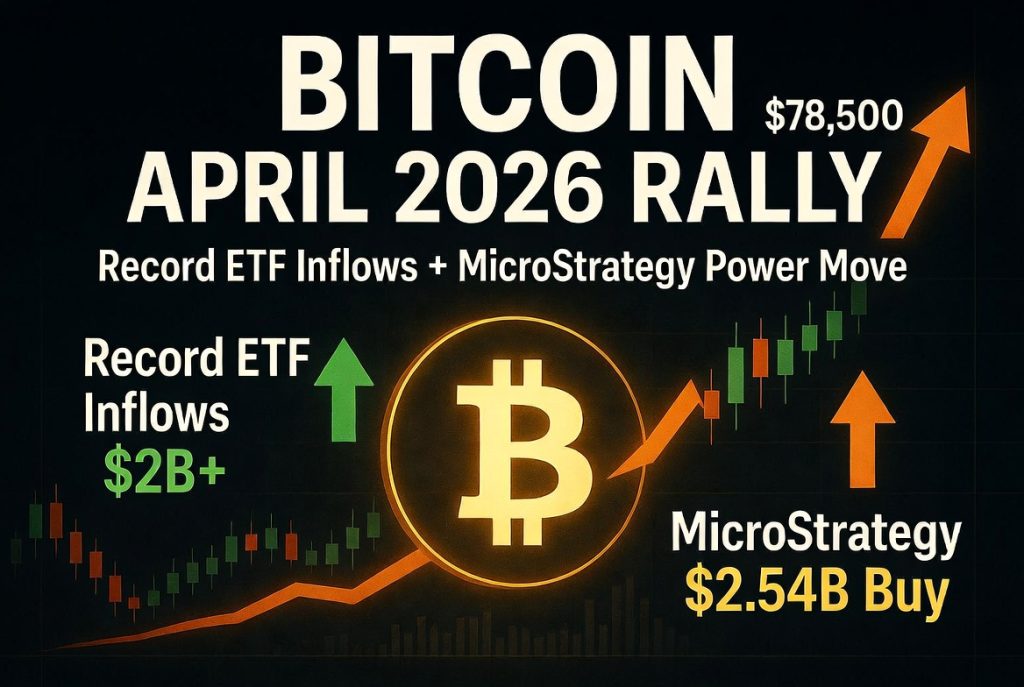
Bitcoin surges in April 2026 as record ETF inflows and MicroStrategy’s massive buy drive the strongest monthly performance since 2020.
Last Updated on August 31, 2026 by Michael Motha
Bitcoin achieved strong gains in April 2026, driven by spot ETF demand, treasury purchases, and institutional participation. The month’s momentum highlighted maturing market infrastructure and stable organic spot buying rather than excessive speculative leverage.
The Numbers Behind Bitcoin’s April 2026 Surge
Bitcoin entered the month trading near $68,000 before breaking decisively above $74,000 resistance and testing the $78,000–$78,500 range by month-end. This 13.71% monthly gain outpaced historical averages and successfully erased earlier drawdowns, supported by neutral perpetual funding rates that signal genuine spot buying rather than speculative leverage. On-chain metrics track a sustained ETF inflow streak as detailed in tracking updates from CoinDesk Market Reports alongside continuous whale accumulation, while retail sentiment remains firmly in “Fear” at 31 on the Fear & Greed Index, creating a classic structural foundation for institutional upward price pressure.
ETF Inflows: The Institutional Demand Engine
Institutional capital reallocation from pensions, endowments, and registered investment advisors continues to fundamentally reshape cryptocurrency market liquidity. Spot ETFs effectively eliminate traditional custody friction, delivering institutional-grade daily liquidity options that major market participants previously lacked. This structural change creates a consistent demand engine, with daily fund acquisitions frequently absorbing vast portions of liquid mining output regardless of near-term macroeconomic volatility.
MicroStrategy’s Record-Breaking Bitcoin Strategy
U.S. spot Bitcoin ETFs added roughly $1.97 billion in net inflows during April, pushing sector assets back above $100 billion. MicroStrategy further expanded its treasury holdings by acquiring 34,164 BTC for $2.54 billion at an average price of $74,395, as disclosed in filings with the U.S. Securities and Exchange Commission (SEC). Both institutional ETF allocations and corporate balance sheet strategies created a reinforcing supply dynamic.
Macro and Geopolitical Tailwinds
The market rally unfolded against a complex macroeconomic backdrop. Initial volatility tied to geopolitical headlines subsided rapidly as Bitcoin demonstrated significant resilience compared to traditional safe havens like gold. Trading against shifting indicators and a weakening U.S. Dollar, Bitcoin displayed a notable negative correlation to the DXY index, strengthening its narrative as a digital asset inflation hedge. Institutional analysts currently view $74,000 as crucial baseline support, with major overhead resistance forming near $82,000 as the broader blockchain ecosystem matures.
What the April Rally Revealed About Bitcoin’s Market
The April rally highlighted how closely Bitcoin’s price performance can be influenced by institutional flows, ETF demand and corporate treasury activity. These factors do not guarantee a sustained upward trend, but they have become increasingly important components of Bitcoin’s market structure.
For individual investors, April 2026’s price action underscores a maturing market. ETF accessibility lowers barriers; corporate precedent validates long-term holding; and improving regulatory clarity (including discussions around a potential U.S. Strategic Bitcoin Reserve) reduces tail risk.
Readers interested in broader technology developments that complement Bitcoin’s institutional maturation can explore the full Altcoin News on Crypto News Online Hub.
Layer-2 solutions such as Lightning Network, stablecoin infrastructure, and tokenized real-world assets continue to build on Bitcoin’s base layer. While the king’s price remains the macro signal for the entire crypto sector, selective altcoin rotation has begun. Bitcoin dominance remains elevated — a healthy dynamic that historically precedes broader market rallies.
Technical analysts highlight key levels: $74,000 as strong new support and $82,000–$83,000 (near the 200-day EMA) as the next major resistance. A decisive break above $80,000 could open the path toward new 2026 highs.
Risks and Catalysts for the Remainder of 2026
Near-term catalysts include month-end ETF flow reports, potential further corporate announcements from firms emulating MicroStrategy, and any clarity on U.S. regulatory or fiscal policy. Risks center on sudden geopolitical escalation, unexpected tightening in liquidity conditions, or profit-taking after the strong monthly performance.
Bitcoin’s April performance highlighted the growing influence of institutional flows on the digital-asset market. Spot ETF demand and corporate treasury purchases provided important sources of buying pressure, while broader macroeconomic conditions continued to influence sentiment.
The April rally therefore offers a useful snapshot of Bitcoin’s evolving market structure. Whether similar institutional demand can be sustained will depend on future ETF flows, corporate treasury decisions, liquidity conditions and the wider economic environment.

Michael Motha is the Founder and Managing Director of CryptoNewsOnlineHub and works as a freelance Project Head. He is a dedicated Crypto enthusiast and researcher focusing on blockchain trends, digital assets, and emerging crypto technologies. With academic qualifications in Physics, MBA, and B.Ed from Loyola College, Chennai, he brings clarity to complex crypto topics through insightful content. Outside of crypto, he enjoys blogging, travel, music, and sports such as badminton and tennis.