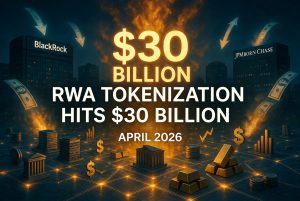

Real World Asset Tokenization Is Reshaping Global Finance as Blockchain Enters a New Era

Real World Asset tokenization is opening new investment opportunities through blockchain technology.
Last Updated on July 26, 2026 by Michael Motha
Introduction
For years, blockchain technology was primarily associated with cryptocurrencies such as Bitcoin and Ethereum. Today, however, the industry is undergoing a significant transformation. Rather than focusing solely on digital currencies, financial institutions, investment firms and technology companies are increasingly exploring how blockchain can represent ownership of tangible assets in digital form.
This evolution is known as Real World Asset (RWA) tokenization. By converting ownership rights of physical and financial assets into blockchain-based digital tokens, organisations are discovering new ways to improve efficiency, enhance transparency and broaden investment access.
Industry analysts believe tokenization has the potential to become one of blockchain’s most important long-term use cases. Instead of viewing blockchain simply as infrastructure for cryptocurrencies, institutions are increasingly recognising its ability to modernise capital markets, streamline transactions and unlock liquidity across previously illiquid assets.
Our
category regularly examines how distributed ledger technology is transforming traditional industries, while the Crypto News section continues covering the broader evolution of digital assets and institutional adoption.
Key Takeaways
- Real World Asset tokenization is becoming one of blockchain’s fastest-growing sectors.
- Institutional investors are expanding research into tokenised financial products.
- Blockchain technology improves transparency, settlement efficiency and ownership verification.
- Tokenization could reshape global investment markets over the coming decade.
- Regulatory clarity remains a key factor influencing long-term adoption.
What Is Real World Asset Tokenization?
Real World Asset tokenization refers to the process of representing ownership of physical or traditional financial assets on a blockchain network. These assets may include commercial property, residential real estate, government bonds, corporate debt, commodities, fine art, infrastructure projects and even intellectual property.
Each token represents a defined ownership interest, enabling assets to be transferred digitally while maintaining transparent transaction records. Smart contracts automate many administrative processes that traditionally require multiple intermediaries, reducing both settlement times and operational costs.
Unlike speculative cryptocurrencies, tokenised assets derive their value from identifiable real-world investments. This distinction is attracting growing interest from institutional investors seeking blockchain applications with measurable economic value.
Why Financial Institutions Are Paying Attention
Institutional attitudes towards blockchain have changed considerably over recent years. Early concerns surrounding volatility and regulatory uncertainty have gradually shifted towards evaluating practical applications capable of improving existing financial infrastructure.
Asset managers now recognise that blockchain technology can simplify ownership records, improve settlement efficiency and increase market accessibility. Instead of processing transactions through multiple intermediaries over several business days, tokenised assets can potentially settle much faster while maintaining transparent audit trails.
Investment firms also see opportunities to expand investor participation by allowing fractional ownership of traditionally expensive assets. Commercial buildings, private equity investments and infrastructure projects that once required substantial capital commitments may eventually become accessible to a broader range of investors through tokenisation.
Recent market information available from CoinMarketCap demonstrates continuing growth across blockchain-based digital asset ecosystems, reflecting increasing investor interest beyond traditional cryptocurrencies.
Investors following institutional blockchain adoption may also benefit from reading our Market Analysis coverage, where we regularly examine long-term trends affecting digital assets and financial innovation.
Beyond Cryptocurrencies: Expanding Blockchain Utility
One of blockchain’s greatest strengths lies in its ability to establish trusted digital ownership without relying entirely on centralised record-keeping systems.
Traditional financial transactions often involve custodians, brokers, clearing houses and settlement agents. Each intermediary increases processing complexity, costs and administrative overhead.
Blockchain technology offers an alternative model where ownership transfers can be securely recorded through decentralised consensus mechanisms. Although regulatory frameworks continue evolving, many financial institutions view this technology as an opportunity to modernise outdated infrastructure rather than replace existing financial systems entirely.
Bitcoin.org describes blockchain as a decentralised network that enables secure peer-to-peer value transfer without requiring central authority approval. While Bitcoin remains primarily a digital currency, the underlying blockchain principles continue inspiring broader financial innovation.
Fractional Ownership Opens New Investment Opportunities
Perhaps the most transformative aspect of tokenization is fractional ownership.
Historically, investing in premium commercial real estate, infrastructure projects or fine art required substantial financial resources. Tokenization enables these assets to be divided into smaller digital units, allowing investors to purchase proportional ownership.
This democratisation of investment has the potential to increase market liquidity while expanding participation across previously inaccessible asset classes.
For developers, governments and institutional asset managers, tokenization also creates opportunities to raise capital more efficiently by connecting global investors with high-value projects through secure blockchain networks.
Readers exploring emerging investment sectors beyond Bitcoin may also find valuable insights within our Altcoin News coverage, where innovative blockchain projects and decentralised finance platforms are analysed regularly.
Institutional Adoption Accelerates
While early blockchain adoption was largely driven by retail investors and technology enthusiasts, the current phase of industry growth is increasingly being shaped by institutional participation. Banks, investment managers, insurance companies and financial technology providers are investing significant resources into blockchain research and digital asset infrastructure.
One of the strongest drivers behind this trend is operational efficiency. Traditional settlement processes often involve multiple intermediaries, manual verification procedures and lengthy processing times. Tokenised assets supported by blockchain networks offer the potential to simplify these workflows while improving transparency and reducing administrative costs.
Several global financial organisations are actively exploring how tokenisation could modernise securities, bonds and alternative investment markets. BlackRock has repeatedly highlighted the long-term potential of tokenisation within capital markets, while Fidelity continues expanding its digital asset capabilities as institutional demand grows.
Readers interested in broader developments across institutional investment can also explore our Crypto News category, where we regularly examine how traditional finance continues integrating blockchain technology into mainstream financial services.
Ethereum Continues Leading the Tokenization Revolution
Although several blockchain platforms now support tokenisation, Ethereum remains one of the industry’s leading ecosystems due to its mature smart contract capabilities and extensive developer community.
Smart contracts automate transactions, ownership transfers and compliance rules without requiring constant manual intervention. This technology significantly reduces operational complexity while improving transparency for investors and financial institutions.
Ethereum’s ecosystem also supports decentralised finance (DeFi), stablecoins, tokenised securities and numerous enterprise blockchain solutions, making it a preferred platform for many tokenisation initiatives.
Ethereum.org continues publishing educational resources explaining how programmable blockchain infrastructure enables developers to build secure decentralised applications for financial services, supply chain management and digital identity.
Those following protocol upgrades, staking developments and ecosystem expansion can continue reading our Ethereum News section for comprehensive coverage of one of blockchain’s most influential networks.
Opportunities Beyond Traditional Investments
Tokenisation extends far beyond commercial property or government bonds. Industry experts increasingly believe blockchain could reshape numerous sectors over the coming decade.
Potential applications include:
- Precious metals
- Carbon credits
- Renewable energy projects
- Infrastructure financing
- Intellectual property
- Music royalties
- Fine art collections
- Agricultural assets
- Private equity
- Supply chain finance
Each of these markets faces challenges related to ownership verification, liquidity or administrative complexity. Blockchain technology offers practical solutions that may simplify these processes while creating new investment opportunities for individuals and institutions alike.
Challenges Still Remain
Despite growing optimism, Real World Asset tokenisation still faces several important challenges before achieving widespread adoption.
The first is regulatory clarity. Different jurisdictions continue developing their own approaches to digital asset regulation, creating uncertainty for institutions operating across multiple markets.
Guidance published by the SEC continues influencing how financial institutions assess tokenised securities, compliance obligations and investor protection as digital asset markets continue to evolve.
Guidance published by the SEC continues influencing how investment firms evaluate tokenised securities, compliance obligations and investor protection standards.
Another challenge involves interoperability. Multiple blockchain networks currently operate using different technical standards, making seamless communication between ecosystems more complex.
Security also remains a priority. Although blockchain itself provides strong cryptographic protection, vulnerabilities may still arise through smart contract coding errors, third-party applications or digital asset custody providers.
Finally, investor education remains essential. Many potential participants still associate blockchain exclusively with cryptocurrencies rather than understanding its broader applications within traditional finance.
Readers seeking ongoing commentary about industry risks and investment trends may also benefit from visiting our Market Analysis section.
Market Analysis
The tokenisation market continues evolving from experimental pilot programmes towards commercially viable financial infrastructure.
Institutional investment remains one of the strongest indicators supporting long-term blockchain adoption. Rather than replacing existing financial systems overnight, blockchain is increasingly complementing traditional infrastructure by improving efficiency within selected market segments.
Market statistics available through CoinGecko demonstrate continued expansion across blockchain ecosystems supporting decentralised finance, tokenisation and digital asset innovation.
Investor sentiment has also matured considerably. Discussions increasingly focus on practical business applications, regulatory frameworks and long-term infrastructure development rather than short-term speculation.
This shift represents one of the industry’s most important structural changes.
What Could Happen Next?
Over the coming years, analysts expect several important trends to shape the future of tokenisation.
Greater regulatory clarity may encourage additional institutional participation.
Improved blockchain interoperability could simplify cross-border transactions.
Artificial intelligence may automate compliance, fraud detection and portfolio management across tokenised financial products.
Global exchanges such as Binance continue investing in digital asset infrastructure designed to support institutional clients, while Coinbase is expanding custody and trading solutions for professional investors seeking regulated market access.
As blockchain adoption accelerates, collaboration between governments, regulators, technology providers and financial institutions will become increasingly important.
Final Thoughts
Real World Asset tokenisation represents far more than another blockchain trend. It reflects a fundamental shift in how ownership, investment and financial infrastructure may operate during the coming decade.
Institutional participation, regulatory progress and technological innovation are gradually transforming blockchain from a niche technology into an increasingly practical foundation for global finance.
Although challenges remain, the direction of travel appears clear. Financial markets are steadily embracing digital infrastructure capable of improving efficiency, increasing transparency and expanding access to investment opportunities.
For investors, businesses and policymakers alike, understanding tokenisation today may prove essential for navigating tomorrow’s increasingly digital financial landscape.
Frequently Asked Questions
Real World Asset tokenisation is the process of converting ownership rights of physical or traditional financial assets into blockchain-based digital tokens that can be traded or transferred securely.
Institutions view tokenisation as a way to improve settlement efficiency, reduce costs, increase transparency and expand access to investment opportunities.
Ethereum remains one of the most widely used blockchain platforms because of its mature smart contract ecosystem, although several other blockchain networks also support tokenised assets.
No. Most experts believe blockchain will complement existing financial infrastructure rather than replace it entirely, improving efficiency within many financial processes.
Real estate, government bonds, commodities, infrastructure, private equity, carbon credits, intellectual property, supply chain finance and renewable energy are among the sectors expected to benefit.

Michael Motha is the Founder and Managing Director of CryptoNewsOnlineHub and works as a freelance Project Head. He is a dedicated Crypto enthusiast and researcher focusing on blockchain trends, digital assets, and emerging crypto technologies. With academic qualifications in Physics, MBA, and B.Ed from Loyola College, Chennai, he brings clarity to complex crypto topics through insightful content. Outside of crypto, he enjoys blogging, travel, music, and sports such as badminton and tennis.