

CoinGecko Ranks Crypto Narratives Based on ROI — The Biggest Winners Explained

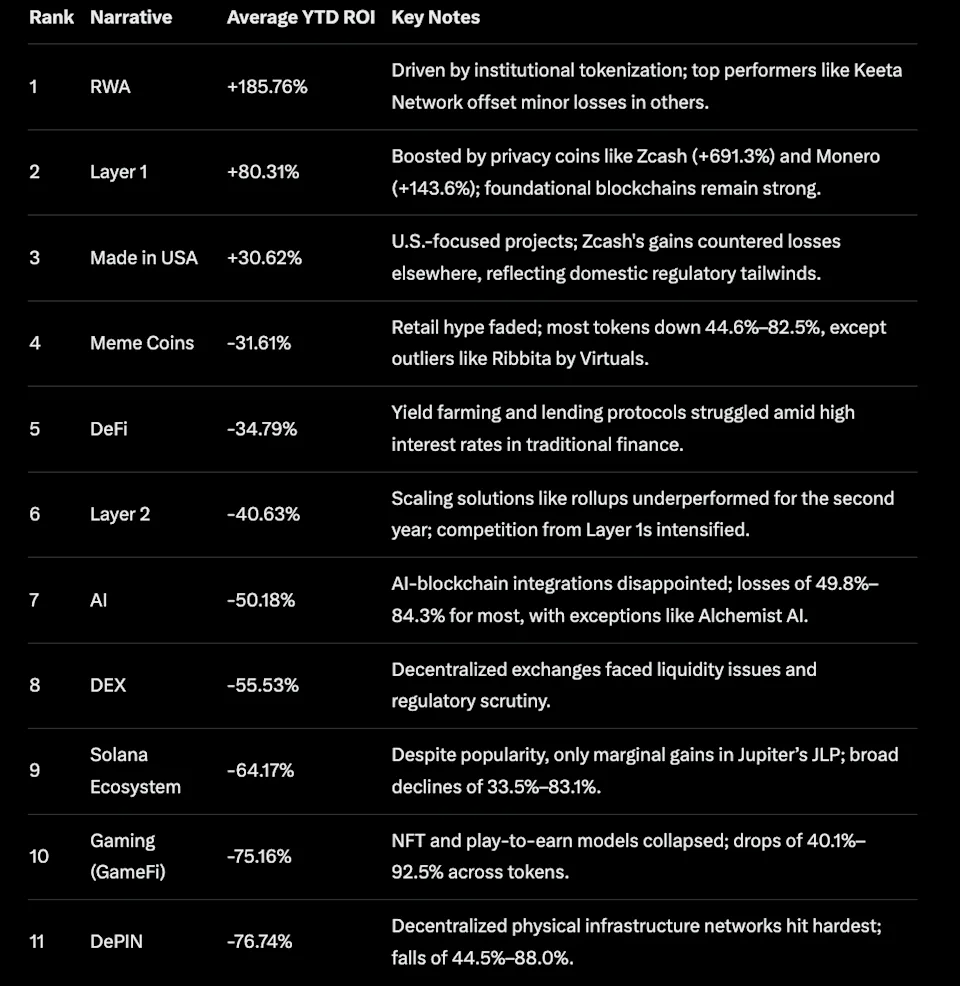
Only three narratives posted positive returns: RWA, Layer 1 blockchains at 80.31%, and Made in USA projects at 30.62%. | Credit: CCN.
Last Updated on December 28, 2025 by Admin
Crypto Narratives in 2025: Winners, Losers, and the Shift Toward Real-World Value
The cryptocurrency market in 2025 has been defined by sharp contrasts. While some narratives delivered exceptional returns and attracted institutional confidence, others collapsed despite massive online attention. A deep look at narrative-based performance reveals a market that is maturing, rotating away from hype, and increasingly rewarding tangible utility.
This year’s data shows that not all popular crypto themes are profitable, and not all profitable ones dominate social conversations. Instead, 2025 highlights a structural shift toward real-world integration, regulatory alignment, and infrastructure-driven growth.
Real-World Assets Take the Lead
Real-World Assets (RWA) emerged as the most profitable crypto narrative of 2025, delivering average returns exceeding 180%. This category includes projects that tokenize traditional financial instruments such as government bonds, private credit, commodities, and real estate.
The strong performance of RWA reflects growing confidence from institutional investors. Tokenization allows off-chain assets to be represented on blockchains, improving liquidity, transparency, and global accessibility. As traditional finance increasingly explores blockchain rails, RWA projects are positioned as the bridge connecting legacy systems with decentralized networks.

Another factor behind RWA’s success is risk perception. In an environment where volatility remains high, assets tied to real-world value appear more resilient. Investors are increasingly prioritizing yield-generating and asset-backed crypto models over purely speculative tokens.
Institutional Influence Shapes Market Direction
One of the defining forces of 2025 has been the rising influence of institutional capital. Unlike retail-driven bull cycles of the past, institutional participants tend to focus on regulatory clarity, compliance, and long-term sustainability.
This shift has favored narratives like RWA and U.S.-based blockchain projects, while speculative sectors struggled to maintain momentum. Institutions are also playing a role in improving governance standards, custody solutions, and reporting transparency across the crypto ecosystem.
As a result, crypto markets are beginning to resemble traditional capital markets in structure, even while maintaining their decentralized foundations.
Layer 1 Blockchains Remain Strong
Layer 1 blockchains ranked second in overall performance, posting average gains of over 80%. These foundational networks support decentralized applications, smart contracts, and digital asset issuance.
Several factors contributed to their strong showing. Network upgrades improved scalability and transaction efficiency, while expanding developer ecosystems increased real usage. Additionally, Layer 1 projects benefited from renewed confidence in core blockchain infrastructure after years of experimentation with secondary scaling solutions.
The continued strength of Layer 1 networks reinforces the idea that core infrastructure remains essential, even as new narratives emerge.
The Rise of “Made in USA” Crypto Projects
The “Made in USA” narrative also delivered positive returns, averaging over 30% in 2025. This category includes crypto projects headquartered in the United States or closely aligned with U.S. regulatory frameworks.
Investor confidence in these projects has been boosted by clearer policy signals, expanding institutional access, and the growth of regulated crypto investment products. For many investors, regulatory alignment is no longer a drawback but a competitive advantage.
This trend suggests that geography and compliance are becoming increasingly relevant factors in crypto valuation.
Popularity Does Not Equal Profitability
While some narratives performed well financially, others dominated attention without delivering returns. Memecoins remained one of the most discussed crypto categories throughout 2025, yet the sector posted average losses exceeding 30%.
This disconnect highlights a recurring pattern in crypto markets: high engagement and viral momentum do not guarantee sustainable value. Memecoins continue to thrive on community enthusiasm and social amplification, but without strong fundamentals, price volatility remains extreme.
AI Crypto Narratives Lose Momentum
Artificial intelligence-focused crypto projects also underperformed, recording losses of more than 50% on average. Despite strong public interest and association with broader AI innovation, many AI-linked tokens failed to generate consistent revenue or meaningful adoption.
The decline suggests that investors are becoming more selective, distinguishing between genuine technological integration and superficial branding. Simply attaching AI terminology to a blockchain project is no longer enough to sustain long-term price growth.
DeFi, Layer 2, and DEX Tokens Face Headwinds
Several once-dominant narratives struggled in 2025. Decentralized finance (DeFi) tokens posted notable declines, while Layer 2 scaling solutions and decentralized exchanges experienced even steeper losses.
Increased competition, fragmented liquidity, and user fatigue contributed to the downturn. Many protocols also faced pressure from stricter compliance expectations and evolving market structures.
While these sectors remain important to the crypto ecosystem, their 2025 performance reflects a period of consolidation rather than expansion.
Gaming and Infrastructure Narratives Fall Sharply
Gaming-focused crypto projects and decentralized physical infrastructure networks (DePIN) recorded the steepest losses of the year, with declines exceeding 70% in some cases.
Despite long-term potential, many of these projects struggled to convert vision into sustainable revenue. Play-to-earn models faced declining user engagement, while infrastructure-based projects required capital and timelines beyond what speculative markets were willing to tolerate.
These results underscore the challenges of aligning ambitious innovation with market expectations.
A Market in Transition
Compared to 2024, the narrative landscape of 2025 looks dramatically different. Last year’s top performers — particularly AI and memecoins — reversed course sharply, while previously overlooked sectors surged ahead.
This rotation reflects a broader maturation of the crypto market. Investors are increasingly focused on utility, yield, and integration with existing financial systems. Short-term hype still exists, but its influence on long-term returns appears to be diminishing.
The Growing Gap Between Hype and Value
One of the most important takeaways from 2025 is the widening gap between attention and profitability. Narratives that attracted the most online discussion were often among the weakest performers, while quieter sectors delivered superior returns.
This trend suggests that investors who rely solely on social sentiment may face higher risks, while those focused on fundamentals could benefit from more consistent outcomes.
Looking Ahead
As crypto moves forward, real-world relevance is becoming a defining factor. Tokenization, regulatory alignment, and infrastructure development are shaping the next phase of growth.
While speculative narratives will continue to emerge, the 2025 performance data indicates that markets are increasingly rewarding projects with clear use cases and sustainable models.
The crypto industry remains dynamic and unpredictable, but one message is clear: in a maturing ecosystem, substance is beginning to matter more than story.