AI Crypto Security Faces New Test as Cross-Chain Exploit Exposes Bridge Risks
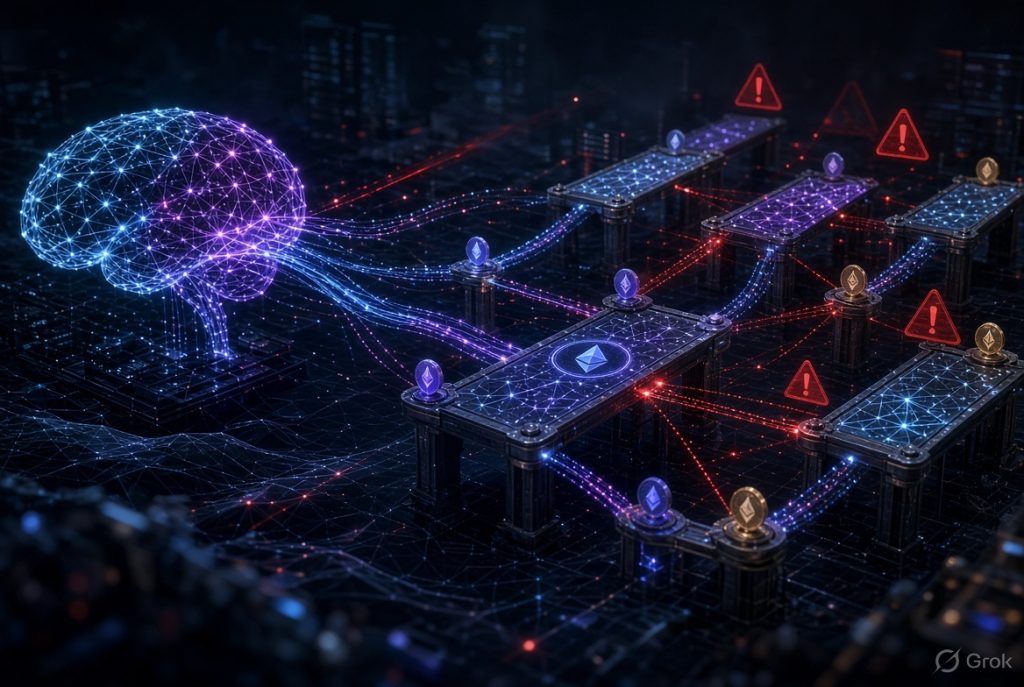
A widening cross-chain exploit highlights security challenges facing AI-linked crypto infrastructure.
Last Updated on September 21, 2026 by Michael Motha
Artificial intelligence and blockchain are increasingly being built together, but a recent security incident is showing why the infrastructure connecting these technologies may deserve as much attention as the applications themselves.
A widening exploit involving AI-linked crypto projects has raised questions around cross-chain bridges, compromised signing credentials and unauthorized token creation. The incident began with activity involving Fetch.ai and NuNet before expanding to the SingularityNET bridge and World Mobile Token ecosystem.
The reported activity demonstrates how a single compromised component can create consequences across several interconnected blockchain projects. It also provides a timely reminder that decentralized applications can still depend on centralized operational keys, backend systems and trusted signing mechanisms.
For the growing AI-crypto sector, that distinction is becoming increasingly important.
Snapshot
- A coordinated attack affected several projects connected to the Artificial Superintelligence ecosystem.
- Millions of tokens were drained or created without authorization.
- The incident expanded from Fetch.ai and NuNet to the SingularityNET bridge and World Mobile Token ecosystem.
- Security researchers tracked approximately $16.77 million in crypto assets associated with the attacker at one point.
- The episode highlights risks involving private keys, bridge infrastructure and token-minting permissions.
- The wider AI-crypto sector may face increasing pressure to demonstrate stronger security controls as adoption expands.
How the AI-Linked Crypto Exploit Unfolded
The incident first drew attention after an attacker drained approximately 8.7 million FET from a Fetch.ai conversion contract. The same attacker was subsequently linked to the unauthorized minting of hundreds of millions of NuNet tokens.
The activity then expanded further. Blockchain intelligence reporting identified unauthorized minting involving approximately 260 million AGIX and 53.8 million WMTx on Ethereum. The tracked asset holdings associated with the attacker were later estimated at roughly $16.77 million.
That progression matters because the affected projects are not isolated from one another. They have overlapping infrastructure and relationships within the broader decentralized AI ecosystem.
Fetch.ai has also stated that its own contracts were not currently under threat and that FET continued operating normally, while AGIX-to-FET conversions were paused as a precaution.
The situation therefore illustrates an important difference between an individual project’s core smart contracts and the wider infrastructure used to move assets between networks.
Why Cross-Chain Bridges Remain a Major Security Challenge
Cross-chain bridges are designed to solve one of blockchain’s most persistent limitations: assets and applications often exist on different networks that do not naturally share the same state.
The SingularityNET bridge, for example, is designed to facilitate token transfers between Ethereum and Cardano. Its documentation explains that the system supports several tokens and uses minting and burning mechanisms as assets move between supported networks.
Official SingularityNET documentation explains the bridge’s cross-chain token-transfer mechanism.
That functionality creates a complicated security environment.
A bridge has to verify that a legitimate event occurred on one network before allowing a corresponding action on another. If an attacker gains control over a signing key, authorization mechanism or privileged backend component, the bridge can potentially be manipulated even when the underlying blockchain itself remains secure.
This is why bridge security is increasingly becoming a central issue for blockchain developers.
The problem is not simply whether a smart contract contains a coding vulnerability. Security also depends on how keys are stored, how signatures are generated, how permissions are separated and how unusual transactions are detected.
For background on how AI and blockchain infrastructure are increasingly converging, TechKip has also examined the broader development of decentralized computing and AI infrastructure in its coverage of AI-driven cloud infrastructure modernization.
The Private-Key Problem Behind Decentralized AI
One of the most important lessons from the incident is that decentralization does not automatically eliminate centralized points of control.
Blockchain networks can be decentralized while individual applications still rely on privileged accounts, administrative keys or backend services.
That creates what security researchers often describe as a concentrated point of failure.
If a private key with significant permissions is compromised, an attacker may not need to break the blockchain’s underlying cryptography. Instead, the attacker can potentially use the system’s own authorization mechanisms to produce transactions that appear legitimate to the affected contract.
This distinction is particularly relevant for AI-related blockchain projects because decentralized AI infrastructure frequently combines multiple components: tokens, compute networks, marketplaces, bridges, wallets, data systems and automated services.
The more components that interact, the more difficult the security architecture becomes.
Fetch.ai’s official material provides background on its AI ecosystem and the relationship between decentralized AI infrastructure and the wider ASI ecosystem.
Token Minting Can Create a Different Kind of Risk
A conventional crypto theft generally involves an attacker gaining access to assets that already exist.
Unauthorized token minting introduces another problem.
Instead of simply taking existing tokens, an attacker may create new units that appear legitimate because they originate from a recognized token contract. Those newly created assets can then enter exchanges, liquidity pools or other blockchain applications.
This can distort the token supply and create confusion for exchanges and users attempting to distinguish legitimate holdings from unauthorized ones.
The recent incident illustrates why token supply integrity is so important for blockchain projects connected to AI ecosystems.
Bitquery’s investigation reported that billions of token units across several related assets had been minted or otherwise affected during the incident, illustrating the potential scale of a compromised authorization system.
The technical issue therefore extends beyond the immediate value of assets controlled by an attacker. It can also affect the reliability of supply data and the ability of market participants to determine which tokens should be considered legitimate.
Why AI Crypto Projects Need Stronger Infrastructure
The combination of artificial intelligence and blockchain is attracting interest because each technology addresses different parts of the digital economy.
AI can provide autonomous decision-making, data processing, prediction and automated services. Blockchain can provide programmable ownership, payments, decentralized coordination and verifiable transaction records.
But connecting the two creates additional infrastructure requirements.
AI agents may eventually be able to interact with wallets, decentralized applications and financial protocols automatically. That makes authorization security even more important.
A compromised key today can affect a bridge transaction. A compromised authorization system in a more automated AI economy could potentially give an attacker access to much larger pools of assets or allow unauthorized transactions to be executed at machine speed.
CryptoNewsOnlineHub previously examined the relationship between artificial intelligence and smart contracts in its coverage of Ethereum, AI and smart-contract development.
The broader lesson is that AI-driven automation cannot be separated from the security of the blockchain infrastructure on which those automated systems operate.
The Incident Also Highlights the Importance of Monitoring
Another important development is the role of blockchain intelligence and security-monitoring companies in identifying suspicious activity.
Blockchain transactions are publicly visible, but identifying an attack quickly requires specialized analysis. Security teams can track wallet movements, unusual minting activity, contract interactions and relationships between seemingly separate transactions.
In this case, researchers were able to connect activity involving different projects to the same attacker cluster.
That capability can help exchanges and project teams respond more quickly by freezing deposits, suspending bridge activity or warning users before suspicious assets spread further.
However, monitoring is only one part of the equation.
Once unauthorized tokens have been created, reversing the underlying blockchain transactions may not be possible. The response therefore depends heavily on how quickly affected organizations can identify the problem and coordinate with exchanges, infrastructure providers and users.
What Project Developers Can Learn
The incident offers several practical security lessons for AI and blockchain developers.
First, privileged signing keys should be treated as critical infrastructure rather than ordinary credentials.
Second, permissions should be separated wherever possible. A single key should not automatically have the authority to perform multiple high-impact operations.
Third, bridge systems need transaction-level monitoring capable of identifying abnormal minting, withdrawals and cross-chain activity.
Fourth, emergency controls should be designed before an incident occurs. Projects need clearly defined procedures for pausing affected contracts or limiting suspicious activity.
Finally, security audits should extend beyond smart-contract code.
A contract can behave exactly as programmed while still being exposed through a compromised backend key, oracle, signer or administrative system.
The SingularityNET bridge documentation itself describes a system involving token transfers, minting and burning across networks, demonstrating why the security of the complete operational stack matters rather than only one contract.
The Growing Security Challenge for AI Agents
The next phase of AI development could make these issues even more significant.
AI agents are increasingly being discussed as software systems capable of interacting with digital services rather than simply generating text or answering questions.
In crypto, that could eventually include automated portfolio management, payments, token swaps, decentralized application interactions and machine-to-machine transactions.
CryptoNewsOnlineHub has previously covered the wider shift toward institutional adoption of digital assets, where security and operational infrastructure are becoming increasingly important as traditional financial participants enter the market.
The same principle applies to AI agents.
If an AI system receives permission to interact with blockchain assets, the security model must account not only for human attackers but also for compromised credentials, manipulated data, malicious instructions and automated transaction execution.
That creates a much broader security surface.
Why Bridge Design Could Become a Competitive Factor
For years, blockchain projects competed heavily on transaction speed, fees, scalability and token economics.
Security architecture may become an equally important differentiator.
A bridge that moves assets quickly but relies on a fragile authorization structure can create substantial systemic risk. Conversely, infrastructure with stronger key management, transaction limits, independent verification and rapid emergency controls may provide greater resilience.
That does not mean bridges can eliminate risk completely.
Cross-chain systems inherently introduce complexity because multiple networks, contracts and operational components must work together.
The goal is therefore not simply to eliminate every possible failure. It is to reduce the number of catastrophic failure paths and make abnormal activity easier to detect and contain.
What Users Should Watch After an Exploit
For users holding tokens connected to an affected ecosystem, official communication becomes especially important during a security incident.
Project teams may pause conversions, restrict deposits or withdrawals, disable bridge functionality or introduce additional verification procedures.
Users should be particularly cautious about unsolicited recovery offers, migration links or requests for private keys and seed phrases.
Fetch.ai’s published guidance around ecosystem migrations has previously emphasized relying on official project information and never sharing sensitive wallet credentials.
That principle becomes even more important after a major exploit because attackers frequently attempt to exploit confusion surrounding the original incident.
World Mobile has also previously integrated WMTx with the SingularityNET bridge, highlighting the interconnected nature of the infrastructure affected by the incident.
The Bigger Picture for Decentralized AI
The intersection of AI and crypto is still developing.
Decentralized AI marketplaces, distributed computing, tokenized networks and autonomous agents could eventually become important parts of the digital economy. But those systems will need infrastructure capable of supporting financial activity without creating unnecessary centralized weaknesses.
The current incident does not by itself determine the future of AI-linked crypto projects. It does, however, provide a concrete example of how closely connected infrastructure can turn one compromised component into a wider ecosystem problem.
As the sector grows, security may increasingly become part of the fundamental architecture rather than an additional layer added after deployment.
That could mean greater use of multi-party authorization, hardware-backed key management, transaction limits, independent monitoring, automated anomaly detection and stronger separation between operational systems.
For decentralized AI to mature, the infrastructure supporting it will need to demonstrate not only innovation but also resilience.
Industry Outlook
AI and blockchain are likely to remain closely connected as developers experiment with autonomous agents, decentralized computing and machine-to-machine payments.
The security challenge will grow alongside that development.
Cross-chain bridges will remain useful because blockchain ecosystems are fragmented across multiple networks. At the same time, their role as infrastructure connecting different assets makes them attractive targets.
The recent exploit shows that the security of AI-linked crypto networks cannot be evaluated solely by looking at token prices or the underlying blockchain.
Investors, developers, exchanges and users increasingly need to consider the architecture behind the asset: who controls critical keys, how transactions are authorized, how abnormal activity is detected and how quickly an affected system can be isolated.
CryptoNewsOnlineHub Perspective
The most important takeaway from the latest incident is not simply the amount of cryptocurrency associated with the attacker.
It is the demonstration of how interconnected modern crypto infrastructure has become.
A bridge can connect several projects. A shared ecosystem can connect multiple tokens. A compromised credential can therefore create consequences that extend far beyond the original application.
That becomes even more important as artificial intelligence moves from being a software tool toward becoming an active participant in digital transactions.
AI agents may eventually manage payments, interact with decentralized applications and coordinate resources automatically. Before that happens at large scale, the security foundations underneath those systems will need to become considerably more robust.
The future of AI and crypto may depend as much on secure infrastructure as on the intelligence of the applications built on top of it.
FAQ
An attacker linked to activity involving Fetch.ai and NuNet was subsequently associated with unauthorized minting involving AGIX and WMTx through infrastructure connected to the SingularityNET bridge. Security researchers tracked approximately $16.77 million in associated crypto assets at one point.
Bridges must coordinate activity between separate blockchain networks. They can therefore depend on smart contracts, signing keys, backend systems and other authorization mechanisms. A weakness in one of these components can potentially affect the movement or creation of assets across networks.
Not necessarily. The reported incident involved specific project infrastructure and authorization mechanisms. Fetch.ai stated that its own contracts were not currently at risk while related conversion activity was paused as a precaution.
Many decentralized AI projects depend on blockchain tokens, bridges, decentralized computing and automated services. Security failures in those components can affect both financial assets and the infrastructure supporting AI applications.
Users should rely on verified announcements from the affected project, avoid unsolicited recovery or migration offers, and never disclose private keys or seed phrases. They should also avoid interacting with unofficial contracts or links shared through unverified accounts.
AI agents could potentially execute blockchain transactions automatically, which may increase both efficiency and the consequences of compromised credentials or malicious instructions. Strong authorization controls and monitoring will therefore become increasingly important as agentic crypto applications develop.

Michael Motha is the Founder and Managing Director of CryptoNewsOnlineHub and works as a freelance Project Head. A crypto enthusiast and researcher, he focuses on blockchain trends, digital assets, and emerging crypto technologies. With an educational background in Physics, an MBA, and a B.Ed from Loyola College, Chennai, he aims to make complex crypto topics clear and accessible through insightful content.