Nasdaq Backs Tokenized Equities With $100 Million Kraken Investment

Nasdaq is deepening its partnership with Kraken parent Payward to advance tokenized equities and digital financial infrastructure.
Last Updated on September 11, 2026 by Michael Motha
Nasdaq is taking a major step into blockchain-based financial infrastructure with an agreement to invest $100 million in Payward, the parent company of cryptocurrency exchange Kraken.
The investment expands an existing relationship between the traditional stock-market operator and the crypto platform, with both companies working on infrastructure for tokenized equities and always-on financial markets.
The development is significant because it shows how the boundary between traditional securities markets and cryptocurrency infrastructure is continuing to narrow. Rather than treating blockchain as a separate financial ecosystem, major market operators are increasingly exploring how distributed networks can support the issuance, movement and trading of familiar financial assets.
Nasdaq says its partnership with Payward will combine its regulated market infrastructure, surveillance technology and capital-markets expertise with Kraken’s crypto-native execution capabilities and xStocks infrastructure. The companies are also advancing work on Nasdaq Equity Tokens, designed to bring public-company ownership into a tokenized environment.
Key Takeaways
- Nasdaq Ventures has agreed to invest $100 million in Payward, Kraken’s parent company.
- The partnership is focused on tokenized equities and next-generation market infrastructure.
- Nasdaq and Payward are developing infrastructure connecting regulated markets with blockchain networks.
- Nasdaq will also provide market-surveillance technology to Payward’s trading venues.
- Tokenization could eventually make parts of traditional financial markets more programmable and continuously accessible.
- The move adds further institutional momentum to the broader real-world asset tokenization trend.
Nasdaq Makes a Strategic Bet on Tokenization
The investment is more than a conventional financial stake in a cryptocurrency company.
Nasdaq is positioning Payward as a strategic partner in the development of infrastructure that could connect traditional capital markets with blockchain-based financial networks.
Through Nasdaq Ventures, the exchange operator is backing technology and market infrastructure that it believes can support the evolution of global capital markets.
Nasdaq says the expanded relationship combines its capital-markets expertise and market-surveillance capabilities with Payward’s crypto-native infrastructure as both companies work toward tokenized equities and more flexible financial markets.
That combination is particularly important.
Tokenized financial markets cannot depend solely on blockchain technology. They also need mechanisms for market surveillance, investor protection, compliance, liquidity and orderly trading.
Nasdaq’s involvement therefore brings an important traditional-finance component to a sector that has historically been dominated by crypto-native companies.
The official Nasdaq announcement describes the initiative as part of a broader effort to create more connected financial markets while maintaining transparency, governance and market integrity.
What Are Tokenized Equities?
Tokenized equities are digital representations of ownership or economic exposure to publicly traded shares using blockchain infrastructure.
The concept is important because traditional stock markets operate within fixed trading schedules and established settlement systems, while blockchain networks can support digital transactions around the clock.
Tokenization can potentially make securities more programmable and easier to integrate with digital financial applications.
For example, a tokenized security could eventually interact with blockchain-based lending, settlement, collateral management or other financial services without requiring every process to move through separate traditional systems.
However, tokenization does not automatically mean that a blockchain token has exactly the same legal rights as a conventional share.
The rights attached to a token depend on how the product is structured, the jurisdiction involved and the regulatory framework governing it.
That distinction will remain important as more financial institutions enter the sector.
Why the Kraken Connection Matters
Kraken gives Nasdaq access to infrastructure that has been developed specifically for digital-asset markets.
Payward’s xStocks ecosystem is designed to support tokenized exposure to publicly traded equities across blockchain networks. In an earlier partnership announcement, Payward said xStocks had already surpassed $25 billion in transaction volume, including more than $4 billion settled on-chain, with more than 85,000 unique holders across supported networks.
The relationship between the two companies therefore goes beyond simply putting traditional stocks onto a blockchain.
It is an attempt to connect two different financial environments.
One side has regulated exchanges, established securities infrastructure and institutional market participants.
The other has blockchain networks, digital wallets, crypto-native liquidity and around-the-clock trading infrastructure.
Connecting these systems could create a new model for how financial assets are issued and exchanged.
Kraken’s role becomes especially relevant because its platform already serves users who are familiar with digital assets and blockchain-based markets.
For Nasdaq, that provides a potential bridge into a financial environment that operates differently from conventional stock exchanges.
Payward’s own announcement provides additional detail on how its xStocks infrastructure is being positioned to connect tokenized equities with established financial-market infrastructure.
Traditional Finance Is Moving Beyond Bitcoin
The latest development also highlights an important change in institutional crypto adoption.
For years, institutional interest in digital assets was primarily associated with Bitcoin, custody services, exchange-traded products and corporate treasury strategies.
The conversation is now becoming considerably broader.
Banks, exchanges, asset managers and financial technology companies are exploring stablecoins, tokenized bonds, private credit, tokenized funds and digital representations of equities.
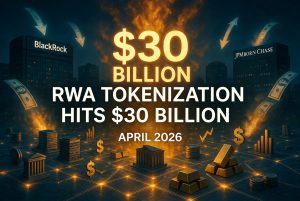
The Nasdaq-Payward initiative fits into the wider movement toward real-world asset tokenization, where traditional financial assets are increasingly being represented and managed through blockchain infrastructure.
The latest Nasdaq-Payward agreement fits directly into that wider transformation.
Instead of asking whether institutions will use blockchain, the more relevant question is increasingly which parts of financial infrastructure will eventually run on blockchain-based systems.
Tokenized Equities Could Create Always-On Markets
One of the most interesting aspects of the Nasdaq initiative is the concept of always-on markets.
Traditional stock exchanges generally operate during defined market hours, with additional limitations depending on geography, settlement systems and market holidays.
Blockchain networks can operate continuously.
If regulated securities can be represented and transferred on compatible digital infrastructure, financial markets could eventually become more flexible in terms of trading availability and settlement.
That does not mean every stock will suddenly trade 24 hours a day.
Regulation, liquidity, market structure and investor protection will continue to determine how tokenized securities operate.
Still, the underlying technology could make financial markets more adaptable.
An investor could potentially interact with tokenized securities through digital financial platforms in ways that are difficult to achieve with conventional infrastructure.
The result could be a gradual shift from markets built around fixed operating windows toward markets capable of supporting continuous digital activity.
The Importance of Market Surveillance
One of the less visible but more important parts of the Nasdaq-Payward agreement is market surveillance.
Nasdaq says Payward will adopt its market-surveillance technology across its trading venues.
This matters because increased tokenization also creates new challenges.
Blockchain transactions can be transparent at the network level, but transparency does not automatically prevent manipulation, abusive trading or other forms of market misconduct.
A mature tokenized securities market needs systems capable of identifying suspicious activity and maintaining confidence among issuers, investors and regulators.
Nasdaq’s surveillance technology could therefore become an important part of the infrastructure supporting the partnership.
This is also a reminder that institutional blockchain adoption is not simply about faster transactions.
It involves building the same layers of trust, oversight and accountability that investors expect from traditional financial markets.
Tokenization Connects Crypto With Real-World Assets
The broader tokenization trend is already moving beyond cryptocurrencies.
Government securities have become an important testing ground because tokenized Treasury products can combine traditional financial assets with blockchain-based settlement.
The same tokenization trend is already visible in government debt markets, where tokenized Treasury products are becoming an important bridge between conventional securities and blockchain-based finance.
The Nasdaq development extends that concept into publicly traded equities.
If tokenized government securities, funds and equities can operate across compatible digital infrastructure, blockchain could gradually become a common settlement and distribution layer for multiple asset classes.
That is where the long-term significance of tokenization becomes clearer.
The objective is not necessarily to replace traditional finance with cryptocurrency.
Instead, blockchain could become another layer of financial infrastructure operating alongside established markets.
Stablecoins Could Provide the Payment Layer
Tokenized securities also need digital money capable of moving efficiently through blockchain-based markets.
That is where stablecoins could become increasingly important.
Stablecoins can provide digital representations of fiat currencies and may support payments, settlement and liquidity within blockchain ecosystems.
The connection between digital money and tokenized securities is becoming increasingly important as financial institutions explore blockchain-based settlement for stocks, bonds and other assets.
The combination of tokenized securities and stablecoins could eventually create a more complete on-chain financial environment.
A tokenized share could represent the asset.
A stablecoin could represent the settlement currency.
Blockchain infrastructure could provide the transfer and settlement mechanism.
Regulated exchanges and financial institutions could provide oversight and market access.
Each component solves a different problem.
Together, they could form a new generation of digital financial infrastructure.
The growing involvement of banks in stablecoin infrastructure could further strengthen this model by providing regulated digital payment and settlement mechanisms for tokenized financial assets.
Nasdaq Is Not Alone in Exploring Tokenized Markets
The momentum around tokenized securities is not limited to one exchange.
Payward also announced a partnership with the London Stock Exchange Group to explore tokenization of UK-listed equities, demonstrating that traditional market infrastructure providers in different regions are examining similar opportunities.
This creates the possibility of a competitive race between exchanges, banks, fintech companies and crypto platforms.
Some firms may focus on token issuance.
Others could concentrate on custody, settlement, liquidity, trading or compliance.
Crypto-native platforms have an advantage in blockchain infrastructure, while traditional financial institutions have decades of experience with regulated markets.
The companies that successfully combine these capabilities could become important players in the next stage of digital finance.
Regulation Remains a Critical Hurdle
Despite the enthusiasm surrounding tokenization, significant challenges remain.
A tokenized share must have clear legal status.
Investors need to understand what rights they actually own.
Issuers need reliable systems for corporate actions, dividends, governance and shareholder records.
Trading platforms need strong compliance and surveillance controls.
Regulators also need frameworks that determine how tokenized securities interact with existing securities laws.
These issues cannot be solved simply by placing an asset on a blockchain.
The technology may improve efficiency, but the underlying legal and financial structure still matters.
This is why Nasdaq’s involvement is particularly notable.
The company is approaching tokenization from the perspective of established capital-market infrastructure rather than treating blockchain as an entirely separate financial system.
What This Means for the Future of Crypto
The Nasdaq-Payward partnership could ultimately prove important even for people who never trade cryptocurrency.
That is because tokenization is changing the definition of the digital-asset industry.
Crypto is increasingly becoming connected to the infrastructure behind stocks, bonds, funds, private credit and other financial assets.
This creates a much larger addressable market than cryptocurrency trading alone.
It also changes the competitive landscape.
Crypto exchanges are no longer simply competing to attract cryptocurrency traders.
Traditional exchanges are entering blockchain markets.
Banks are exploring digital assets.
Asset managers are launching tokenized products.
Technology companies are developing blockchain-based settlement infrastructure.
The boundaries between these industries are becoming increasingly difficult to define.
Risks Should Not Be Ignored
The growth of tokenized assets does not remove the risks associated with cryptocurrency or blockchain markets.
Liquidity can vary significantly between digital assets.
Smart contracts can contain vulnerabilities.
Different blockchain networks may have incompatible standards.
Regulatory treatment can vary between jurisdictions.
There can also be uncertainty around custody, settlement finality and the precise rights attached to tokenized securities.
Institutional participation may reduce some of these risks by introducing stronger compliance and infrastructure standards, but it cannot eliminate them completely.
Investors should therefore distinguish between the technological potential of tokenization and the investment performance of individual digital assets.
A growing tokenization industry does not automatically mean every cryptocurrency associated with it will appreciate.
CryptoNewsOnlineHub Perspective
Nasdaq’s $100 million investment in Payward is a significant signal that tokenization is moving deeper into mainstream financial infrastructure.
The most important part of the announcement is not simply the size of the investment.
It is the combination of Nasdaq’s regulated-market expertise with Kraken’s crypto-native infrastructure.
That partnership could help bridge two financial systems that have traditionally operated separately.
The development also strengthens the broader case for blockchain-based real-world assets.
Tokenized equities, tokenized government securities and stablecoins could eventually operate together within a more connected digital financial ecosystem.
For the cryptocurrency industry, this represents a shift away from viewing blockchain primarily as a technology for creating digital currencies.
Its bigger opportunity may be becoming infrastructure for moving, settling and managing many different forms of financial value.
If that transition continues, institutional adoption could increasingly be measured not only by how much Bitcoin or Ether financial firms hold, but by how much traditional financial infrastructure they are willing to rebuild using blockchain technology.
That may ultimately be the more important transformation taking place across the digital-asset industry.
Frequently Asked Questions
Nasdaq Ventures has agreed to invest $100 million in Payward, the parent company of cryptocurrency exchange Kraken. The investment supports a broader partnership focused on tokenized equities and financial-market infrastructure.
Nasdaq Equity Tokens are part of Nasdaq’s planned framework for representing public-company equity in tokenized form. The initiative is being developed with Payward and its xStocks infrastructure.
Tokenization allows traditional assets such as equities, bonds and funds to be represented within blockchain-based systems. It could improve programmability, settlement efficiency and access to digital financial markets.
No. Tokenized securities and cryptocurrencies serve different purposes. Tokenization expands blockchain’s potential use cases rather than replacing digital currencies.
Yes. Stablecoins could potentially provide digital settlement and liquidity for blockchain-based securities, creating a connection between tokenized assets and digital payments.
No. Tokenized markets still face regulatory, cybersecurity, liquidity, custody, smart-contract and market-manipulation risks. Strong infrastructure and appropriate oversight remain essential.
Final Takeaway
Nasdaq’s investment in Kraken parent Payward marks another important step in the convergence of traditional finance and blockchain technology.
The partnership combines regulated-market infrastructure with crypto-native technology to advance tokenized equities, market surveillance and always-on financial infrastructure.
As more exchanges, banks and asset managers explore tokenization, blockchain’s role in global finance could extend far beyond cryptocurrencies.
The next major phase of digital assets may therefore be less about creating entirely new financial instruments and more about transforming how existing assets are issued, traded, settled and managed.

Michael Motha is the Founder and Managing Director of CryptoNewsOnlineHub and works as a freelance Project Head. A crypto enthusiast and researcher, he focuses on blockchain trends, digital assets, and emerging crypto technologies. With an educational background in Physics, an MBA, and a B.Ed from Loyola College, Chennai, he aims to make complex crypto topics clear and accessible through insightful content.