Why Tokenized Treasury Bills Are Becoming a New Foundation for Digital Finance
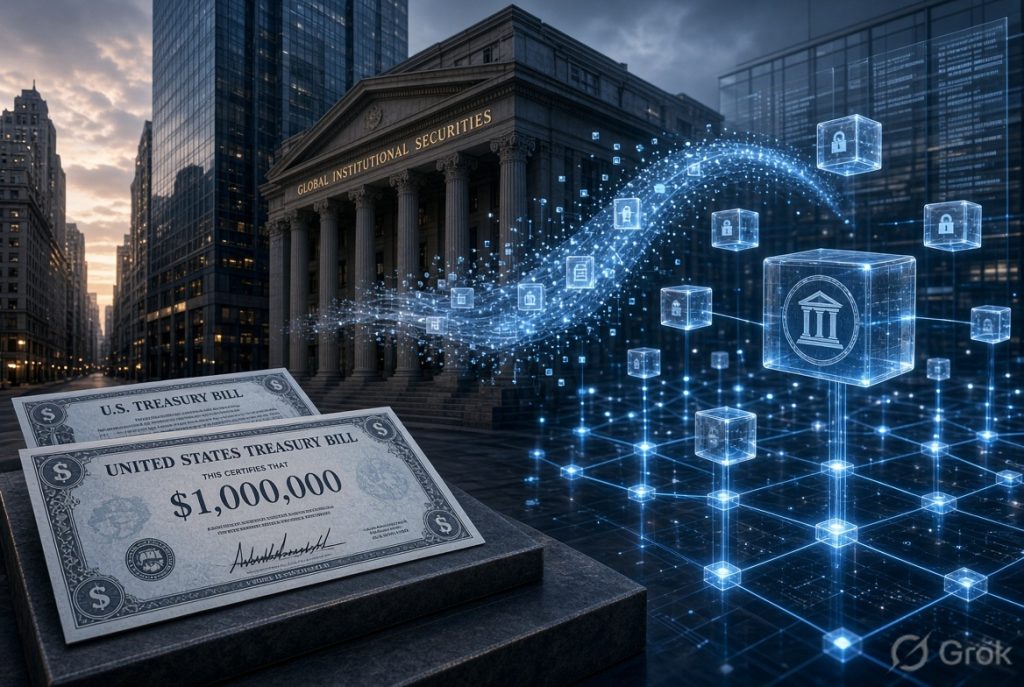
Tokenized Treasury products are emerging as a bridge between traditional government debt and blockchain-based financial markets.
Last Updated on August 22, 2026 by Michael Motha
For years, the cryptocurrency industry has presented blockchain as a way to create an alternative financial system. Yet one of the most interesting developments taking place on public blockchains has little to do with creating a new financial asset.
Instead, blockchain networks are increasingly being used to represent one of the oldest and most widely trusted instruments in global finance: U.S. Treasury securities.
Tokenized Treasury bills and Treasury-backed funds are becoming an important part of the real-world asset market, giving investors and institutions a blockchain-based way to access short-duration government debt and related money-market exposure. The market has expanded rapidly. The CoinGecko 2026 Real-World Asset Report showed tokenized Treasury market capitalization rising from roughly $4 billion at the beginning of 2025 to nearly $13 billion by March 2026.
Other industry research put the market above $13 billion shortly afterward, highlighting how quickly tokenized government debt has moved from a niche experiment toward a meaningful component of digital finance.
That growth matters for a reason that goes beyond the size of the market itself.
The expansion is part of the wider real-world asset tokenization trend, which is bringing traditional financial instruments onto blockchain networks.
Tokenized Treasuries could provide something the crypto economy has historically lacked: a relatively conservative, yield-generating asset that can exist directly on blockchain infrastructure.
That makes the Treasury tokenization story less about replacing traditional finance and more about connecting traditional financial assets with a programmable digital environment.
What Are Tokenized Treasury Bills?
A tokenized Treasury product generally represents an interest in U.S. Treasury securities or a fund that holds those securities through blockchain-based tokens.
The underlying government securities do not simply disappear and become cryptocurrency. Instead, regulated structures are used to connect the blockchain representation with the traditional financial assets held by an issuer, fund, custodian or other financial intermediary.
The result is a digital representation that can potentially be transferred, recorded and integrated with blockchain applications while remaining linked to conventional Treasury exposure.
This distinction is important.
A tokenized Treasury is not the same thing as a new cryptocurrency whose value depends primarily on market speculation. Its economic value is connected to an underlying financial asset.
That makes tokenized Treasuries part of the wider real-world asset, or RWA, movement.
The idea is straightforward: instead of keeping every financial asset inside traditional databases and settlement systems, certain assets can be represented as programmable tokens on blockchain networks.
U.S. Treasuries are particularly suitable for this approach because Treasury bills are standardized, highly liquid and already widely used as collateral and liquidity instruments throughout global finance.
Why Treasuries Became an Early RWA Winner
Real-world asset tokenization covers a huge range of possibilities, including private credit, real estate, commodities, equities, funds and government securities.
Not all of these assets are equally suitable for early blockchain adoption.
A commercial property, for example, involves legal ownership, valuation, maintenance, financing and jurisdictional issues. Private credit can involve complicated underwriting and contractual arrangements.
Short-term government securities are different.
They have standardized structures, transparent pricing, deep traditional markets and an established role in money management.
That combination gives tokenized Treasury products a practical advantage.
The same characteristics are also helping institutional investors explore other forms of tokenized assets, from private credit to tokenized funds.
Coinbase Research has described tokenized U.S. Treasuries as a dominant category within the tokenization landscape, with products from major institutions helping establish the asset class as a core component of institutional on-chain strategies.
The attraction is therefore not simply that Treasuries can be put on a blockchain.
The bigger question is what happens when a yield-generating traditional asset can interact with blockchain-based financial infrastructure.
That is where the story becomes much more interesting.
BlackRock BUIDL Helped Change the Conversation
One of the most important developments in the sector was the launch of BlackRock’s USD Institutional Digital Liquidity Fund, commonly known as BUIDL.
The fund provides investors with exposure to assets including U.S. Treasury bills and cash while using blockchain-based infrastructure for the fund’s digital representation.
Its importance extends beyond the fund itself.
BUIDL demonstrated that one of the world’s largest asset managers was willing to use blockchain technology for a regulated financial product rather than simply experimenting with cryptocurrencies.
Other products have also expanded the market.
Ondo Finance has developed tokenized Treasury-related products, while Franklin Templeton’s on-chain money-market fund has become another prominent example of traditional investment products being represented through blockchain infrastructure. Circle’s USYC and other institutional products have added further competition to the sector.
Together, these products are helping move tokenization away from the proof-of-concept stage.
The important development is not that every investor suddenly wants to hold a Treasury token.
It is that financial institutions are increasingly testing whether blockchain can become part of the plumbing behind asset issuance, settlement and distribution.
The Stablecoin Connection
Tokenized Treasuries and stablecoins are closely connected, even though they serve different purposes.
Stablecoins are designed primarily to provide digital representations of currencies, especially the U.S. dollar. Tokenized Treasury products, by contrast, generally provide exposure to underlying government securities and can generate investment returns.
The relationship becomes clearer when considering what backs many dollar stablecoins.
Stablecoins have consequently become one of the most important bridges between traditional dollars and blockchain-based markets, while the stablecoin market’s expansion highlights the growing connection between digital dollars and traditional financial assets.
This means blockchain-based finance is already deeply connected to the Treasury market.
Stablecoins effectively bring dollars onto blockchain networks, while tokenized Treasury products can bring yield-bearing government securities into the same environment.
That creates the possibility of a financial ecosystem where cash-like digital assets and yield-generating government securities can move between applications without leaving blockchain infrastructure.
The distinction between the two therefore becomes increasingly important.
A stablecoin may be useful for payments and settlement.
A tokenized Treasury product may be useful for earning yield and providing collateral.
Both can potentially become building blocks for on-chain financial markets.
From Investment Product to Digital Collateral
Perhaps the most important development is the possibility that tokenized Treasuries could become collateral for a much wider range of financial activity.
Traditional financial markets already depend heavily on government securities as collateral.
Blockchain-based markets could eventually use tokenized versions for similar purposes.
For example, a tokenized Treasury could potentially be used within eligible lending, trading or structured-finance arrangements, subject to the rules of the relevant platform and product.
This changes the role of the asset.
It is no longer simply an investment product that happens to use blockchain technology.
It can become a piece of financial infrastructure.
Coinbase Institutional’s research on major trends in tokenization highlights the growing importance of tokenized Treasuries and their potential role within on-chain financial markets.
That could be particularly significant for decentralized finance.
DeFi has historically relied heavily on crypto-native collateral. Assets such as Bitcoin and Ether can be productive within lending and derivatives markets, but their prices can also be extremely volatile.
A tokenized short-term government asset introduces a very different type of collateral.
It does not eliminate risk, and it does not automatically make a DeFi protocol safe.
But it could give on-chain markets access to an asset class whose economic characteristics are much closer to traditional money-market instruments.
The development could also have implications for decentralized finance, where the type and quality of collateral can directly influence the products that protocols are able to offer.
Why 24/7 Settlement Matters
One of the strongest arguments for tokenization is not necessarily that blockchains make assets cheaper.
It is that they can change how assets move.
Traditional securities markets operate around established trading hours, settlement cycles, custodial arrangements, banking rails and administrative processes.
Blockchain networks can operate continuously.
A token can potentially be transferred between compatible wallets or platforms at any time, subject to the rules governing the specific security.
This creates the possibility of more flexible settlement and collateral management.
For institutional investors, that could eventually matter more than the novelty of blockchain itself.
Imagine an institution holding a Treasury-linked token that can be moved between approved financial applications without waiting for multiple layers of traditional settlement infrastructure.
The benefit would not necessarily be “crypto versus Wall Street.”
It could be Wall Street using blockchain rails where those rails provide a measurable operational advantage.
Tokenization Does Not Automatically Mean Decentralization
This is where the Treasury tokenization story needs some caution.
A tokenized government bond is not necessarily decentralized.
The underlying securities may still be held by traditional custodians. Investors may have to pass identity and compliance checks. Issuers can impose transfer restrictions, and access may be limited to eligible investors.
There can also be smart-contract, operational, custody, legal and regulatory risks.
In other words, putting an asset on a blockchain does not remove the institutions that control the asset.
In many cases, it simply changes the technology used to represent and transfer the asset.
That distinction is important because the term “tokenization” can sometimes create the impression that traditional financial intermediaries are becoming unnecessary.
The more realistic outcome may be different.
Banks, asset managers, custodians, transfer agents and regulators could remain essential while blockchain becomes another layer in the financial infrastructure.
Regulation Will Shape the Market
The future of tokenized Treasuries will depend heavily on regulation.
A blockchain token representing an interest in a regulated investment product still exists within a legal and financial framework.
Questions around investor eligibility, custody, securities laws, transfer restrictions, taxation, reporting and cross-border access can determine where and how these products are used.
The regulatory discussion is also becoming broader.
The Bank for International Settlements’ research on tokenization and the next-generation monetary and financial system highlights how tokenized assets could become part of a broader transformation in financial infrastructure.
That is an important signal.
Central banks and financial regulators are no longer discussing tokenization solely as a speculative crypto phenomenon.
They are examining whether the underlying technology can improve securities markets, payments and financial intermediation.
The Bigger Opportunity May Be Beyond Retail Crypto
There is a temptation to judge tokenized Treasuries by asking how many individual crypto users will buy them.
That may be the wrong measurement.
The bigger opportunity could involve institutions.
Asset managers could use tokenized securities for distribution and settlement. Financial platforms could use them as collateral. Treasury departments could potentially manage liquidity through programmable financial infrastructure. DeFi protocols could develop new products around compliant tokenized assets.
The result would be a gradual blending of financial systems rather than a sudden replacement of one by another.
This is already visible in the broader tokenization market.
Citi’s research on tokenization argues that public fixed income, particularly Treasury bills, is well suited to tokenization because of its liquidity, standardization and importance in collateral and liquidity markets. The bank’s long-term scenarios include meaningful penetration of the Treasury bill market by tokenized structures.
That does not mean those forecasts will automatically become reality.
But it highlights why government debt has become such an important testing ground for blockchain-based finance.
What Could Stop the Growth?
Despite the rapid expansion, tokenized Treasuries still face significant limitations.
First, liquidity can vary considerably between products. A token may be technically transferable 24/7 without having deep secondary-market liquidity at every moment.
Second, investors remain dependent on the legal structure behind the token. The blockchain record alone does not determine the investor’s rights.
Third, access can be restricted. Some products are designed primarily for institutional or qualified investors rather than the general public.
Fourth, interoperability remains a challenge. A token issued on one blockchain cannot necessarily move freely across every other network or financial platform.
Fifth, smart contracts and digital infrastructure introduce technical risks that traditional securities systems may not have in exactly the same form.
Finally, regulatory fragmentation could slow adoption, particularly when financial products cross borders.
These limitations mean tokenization should not be confused with frictionless finance.
The technology may remove certain forms of friction while creating new requirements elsewhere.
Could Tokenized Treasuries Become the Base Layer of Digital Finance?
The most interesting possibility is that tokenized Treasuries become less visible as they become more useful.
If the market develops successfully, users may not always think about holding a “tokenized Treasury.”
Instead, the asset could sit underneath other financial applications.
A lending platform could use Treasury-backed collateral.
A digital investment account could provide access to tokenized money-market exposure.
A stablecoin ecosystem could connect digital dollars with yield-generating Treasury products.
An institutional trading platform could use tokenized securities for collateral management and settlement.
In that environment, tokenized Treasuries would function more like infrastructure than a standalone crypto narrative.
That is potentially a much bigger development.
A New Relationship Between Crypto and Traditional Finance
The early cryptocurrency movement was built around the idea of creating a financial system outside traditional institutions.
Tokenization is producing a more complicated outcome.
Instead of simply replacing traditional finance, blockchain technology is increasingly being used to represent traditional assets.
Treasuries are an especially clear example.
The underlying asset remains one of the central instruments of conventional finance, but its digital representation can potentially participate in markets that operate on blockchain networks.
This creates a bridge between two financial worlds.
The crypto industry gains access to a deeper pool of traditional assets.
Institutional participation has already become an important theme across the digital-asset industry, particularly as major financial firms explore blockchain-based products and services. The partnership between Pudgy Penguins and asset manager VanEck is one example of established financial firms becoming involved in the digital-asset ecosystem.
Traditional finance gains a new technological framework for issuing, moving and integrating financial instruments.
Neither side has to disappear for the other to grow.
The Treasury Tokenization Story Is Bigger Than Treasuries
The significance of tokenized Treasury bills ultimately comes from what they could enable.
If a standardized, liquid and highly trusted asset can successfully operate within blockchain-based financial infrastructure, the same architecture could potentially be extended to other forms of financial value.
That could include corporate bonds, money-market funds, private credit, equities and other securities.
But Treasuries have an important advantage: the market already understands them.
That makes them a practical starting point for testing how traditional finance and blockchain infrastructure can work together.
The growth of tokenized Treasury products therefore deserves attention even from investors who have little interest in buying another cryptocurrency.
The real story is not simply about putting government debt on a blockchain.
It is about testing whether financial assets can become programmable, continuously transferable and natively integrated with digital markets while retaining the legal and economic foundations of traditional finance.
If that model continues to mature, tokenized Treasuries could become one of the quiet building blocks of the next generation of digital financial infrastructure.
And that may prove more important than the latest crypto trend that dominates headlines for a few weeks.

Michael Motha is the Founder and Managing Director of CryptoNewsOnlineHub and works as a freelance Project Head. A crypto enthusiast and researcher, he focuses on blockchain trends, digital assets, and emerging crypto technologies. With an educational background in Physics, an MBA, and a B.Ed from Loyola College, Chennai, he aims to make complex crypto topics clear and accessible through insightful content.